











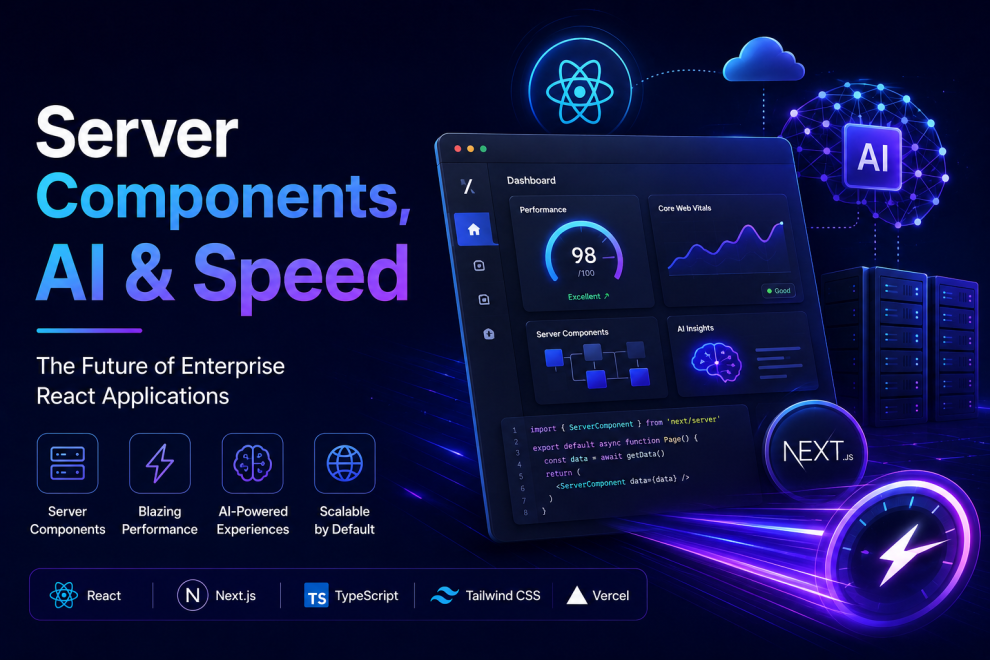

Modern enterprises are under increasing pressure to deliver digital products faster while maintaining exceptional performance, security, and scalability. Customers expect near-instant page loads, developers demand efficient workflows, and business leaders need platforms that can evolve with changing market demands.
This is why Next.js has become one of the most influential frameworks in the React ecosystem. By combining server-side rendering, static generation, React Server Components, and powerful optimization capabilities, Next.js enables organizations to build enterprise applications that are fast, SEO-friendly, and ready for AI-powered experiences.
For enterprises investing in digital transformation, adopting Next.js is no longer just a technical decision it has become a strategic advantage.
Why Enterprise Teams Are Choosing Next.js
React transformed frontend development by introducing component-based architecture and reusable UI. However, as applications grew larger, organizations faced challenges around SEO, performance, and scalability.
Next.js addresses these challenges by providing enterprise-ready capabilities such as:
– Server-Side Rendering (SSR)
– Static Site Generation (SSG)
– Incremental Static Regeneration (ISR)
– React Server Components
– Streaming UI
– Built-in image optimization
– API routes
– Edge Runtime support
These features help engineering teams build applications that perform well while reducing development complexity.
React Server Components Are Changing Application Architecture
One of the biggest advancements in modern React development is the adoption of React Server Components.
Instead of sending large amounts of JavaScript to the browser, components can now render on the server, reducing bundle sizes and improving page performance.
Key benefits include:
– Faster page loads
– Better Core Web Vitals
– Reduced client-side JavaScript
– Improved SEO
– Lower infrastructure costs
– Enhanced user experience
For enterprise applications with large datasets and complex interfaces, these improvements can significantly impact user satisfaction and operational efficiency.
AI Is Reshaping React Applications
Artificial intelligence is becoming a core capability of enterprise software.
Next.js provides an excellent foundation for integrating AI-powered experiences such as:
– Intelligent search
– AI chat assistants
– Personalized dashboards
– Automated content generation
– Workflow recommendations
– Natural language interfaces
By combining server-side rendering with AI services, organizations can deliver responsive experiences without compromising performance.
Performance Directly Impacts Business Results
Speed is no longer simply a technical metric.
Slow applications reduce engagement, lower conversions, and negatively impact customer satisfaction.
Enterprise teams should prioritize:
– Optimized images
– Streaming rendering
– Route prefetching
– Efficient caching
– Code splitting
– Edge delivery
– Lazy loading
Together, these optimizations create applications that remain responsive even under heavy traffic.
Security and Scalability by Design
Enterprise applications process sensitive customer and operational data.
Next.js supports secure application development through server-side execution, API routes, authentication integrations, and flexible deployment options across cloud platforms.
Combined with scalable architecture and modern DevOps practices, organizations can confidently support millions of users while maintaining strong security standards.
Industry Perspective
Across enterprise product engineering, organizations are increasingly adopting React and Next.js as foundational technologies for building scalable digital platforms. Companies such as GeekyAnts have publicly showcased projects using modern React ecosystems across healthcare, fintech, retail, and SaaS, reflecting a broader industry trend toward combining high-performance frontend engineering with strong UX principles and cloud-native architectures.
What’s Next for Next.js?
The future of enterprise web development will be shaped by AI-native interfaces, Edge Computing, React Server Components, partial prerendering, and increasingly intelligent user experiences.
Organizations that invest in modern React architectures today will be better prepared to deliver secure, scalable, and high-performing applications that meet evolving customer expectations.
Frequently Asked Questions
Why is Next.js preferred over a traditional React application?
Next.js provides built-in features such as server-side rendering, static generation, routing, image optimization, and performance enhancements that reduce development effort while improving scalability and SEO.
Is Next.js suitable for enterprise applications?
Yes. Large enterprises use Next.js because it supports modern rendering strategies, strong performance, scalability, security integrations, and excellent developer productivity.
How does Next.js improve SEO?
Next.js enables pages to be rendered on the server before reaching the browser, making content easier for search engines to crawl while improving page speed and Core Web Vitals.
Conclusion
Enterprise web applications are becoming more intelligent, interactive, and performance-driven.
Next.js provides the flexibility, scalability, and developer experience needed to build these modern applications while taking full advantage of the React ecosystem.
For organizations planning their next generation of digital products, investing in Next.js is not simply about adopting a framework it is about creating a foundation that supports long-term innovation, exceptional user experiences, and sustainable business growth.










Add Comment