











Enterprise IoT initiatives are no longer experimental projects operating inside isolated business units. Across manufacturing, logistics, healthcare, retail, utilities, and connected infrastructure, IoT platforms now sit directly inside revenue operations, customer experience systems, and enterprise decision making.
That shift is creating a different kind of pressure for engineering leadership teams.
The challenge is no longer about connecting devices to the cloud. Most enterprises already solved that problem years ago. The real challenge now is operational scalability. Teams are struggling to deliver IoT dashboards that remain responsive under millions of data events, support distributed user bases, integrate with legacy systems, and still move fast enough to meet changing business requirements.
Many organizations are discovering that their existing frontend architecture is becoming a bottleneck.
Legacy dashboard frameworks often create performance issues once telemetry volume increases. Development teams end up maintaining fragmented frontend systems that slow release cycles. Security and compliance requirements add additional layers of complexity, especially in North American enterprise environments where platform reliability directly impacts operational continuity.
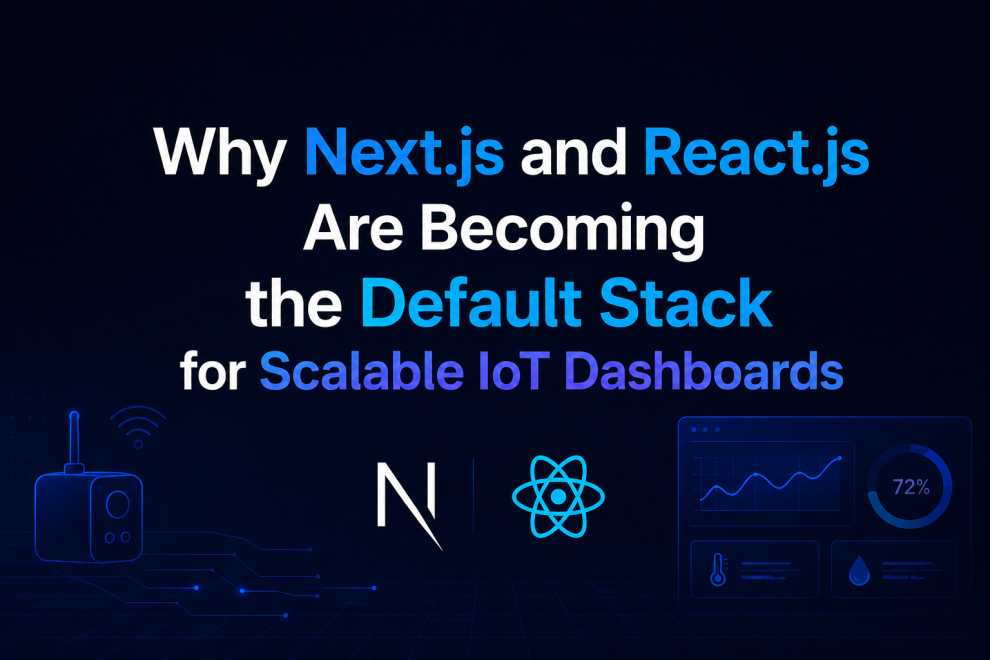
This is one reason Next.js and React.js are increasingly becoming the preferred frontend stack for modern IoT dashboards.
The shift is not happening because these technologies are trendy. It is happening because engineering organizations need frontend systems that scale operationally without creating long term maintenance debt.
Companies like GeekyAnts, Thoughtworks, and Toptal have increasingly discussed how modern React based architectures are helping enterprises simplify large scale digital platform delivery.
The Enterprise IoT Dashboard Problem Has Changed
A few years ago, IoT dashboards primarily focused on visualization. Today, enterprise platforms are expected to support real time operational intelligence.
That distinction matters.
Modern IoT environments generate massive streams of data from industrial equipment, edge devices, transportation systems, connected products, and customer facing infrastructure. According to Statista, the number of connected IoT devices worldwide is expected to exceed 29 billion by 2030. As enterprise adoption grows, frontend systems are becoming critical operational infrastructure rather than simple reporting interfaces.
This creates several engineering challenges simultaneously:
– Real time rendering at scale
– Cross platform responsiveness
– Faster deployment cycles
– Secure API orchestration
– Lower frontend maintenance overhead
– Better observability for distributed systems
Many enterprise dashboards were not originally designed for this level of operational dependency. As telemetry volume grows, frontend latency becomes visible to customers, operators, and executive stakeholders.
This is where Next.js changes the conversation.
Unlike traditional client side rendered applications, Next.js allows teams to combine server side rendering, edge rendering, static generation, and API layer integration within a unified architecture. That flexibility becomes important for IoT ecosystems where different workloads require different rendering strategies.
For example, a manufacturing operations dashboard may require instant server rendered updates for critical alerts, while historical analytics pages can rely on static optimization for performance efficiency.
React.js complements this architecture by giving teams modular UI scalability. Component driven systems reduce duplication across dashboards, admin panels, monitoring interfaces, and customer portals. Large engineering organizations benefit because platform teams can standardize frontend patterns across multiple business units without rebuilding systems repeatedly.
For enterprise leaders managing hundreds of developers across distributed teams, that standardization directly impacts delivery velocity.
Why Developer Velocity Is Becoming a Business Metric
In enterprise environments, frontend delays now affect more than user experience. They affect operational execution.
When product teams cannot release monitoring updates quickly, field operations slow down. When customer facing dashboards lag during high traffic periods, support tickets increase. When frontend systems require excessive maintenance, engineering budgets rise without improving platform capabilities.
This is one reason technology leaders are prioritizing developer productivity alongside infrastructure scalability.
Next.js and React.js are helping organizations reduce friction across frontend development lifecycles.
The ecosystem maturity matters here. React continues to maintain one of the largest frontend developer ecosystems globally, which reduces hiring constraints for large organizations. Next.js builds on that advantage by simplifying routing, rendering optimization, caching strategies, API integration, and deployment workflows.
For enterprises already investing heavily in cloud infrastructure, this alignment becomes strategically important.
Teams can deploy scalable dashboard architectures across AWS, Microsoft Azure, Google Cloud, and Vercel while maintaining frontend consistency across applications.
The result is not simply faster websites. It is operational resilience.
This is particularly relevant in industries where downtime directly affects logistics operations, industrial workflows, energy systems, or customer transactions. Engineering leaders increasingly need frontend systems that can scale globally without requiring excessive custom infrastructure management.
Another factor driving adoption is observability.
Modern React ecosystems integrate more effectively with analytics, monitoring, and telemetry platforms. That visibility helps platform engineering teams detect frontend bottlenecks before they impact operational KPIs.
In many organizations, frontend performance is now being measured alongside backend reliability metrics.
The Shift Toward Full Stack Operational Platforms
The rise of Next.js also reflects a broader enterprise trend: frontend platforms are becoming full stack operational systems.
Historically, frontend teams operated separately from backend infrastructure teams. That separation often created deployment bottlenecks, fragmented APIs, and inconsistent customer experiences.
Next.js reduces some of this complexity by allowing engineering organizations to unify frontend rendering, backend functions, caching, authentication, and middleware strategies within a single framework.
For enterprise IoT dashboards, this consolidation can significantly reduce platform complexity.
It also improves governance.
Large organizations operating across North America often face compliance requirements related to security, access control, auditability, and infrastructure standardization. Fragmented frontend ecosystems increase governance overhead. Unified architectures simplify operational management.
This is one reason enterprise technology consulting firms are increasingly discussing modern React based architectures during digital transformation engagements.
The conversation is no longer only about frontend modernization. It is about creating scalable operational platforms that support long term business growth.
The companies moving fastest in this space are not necessarily adopting the newest frameworks first. They are adopting architectures that reduce long term operational friction.
That distinction is important.
Technology leaders evaluating IoT dashboard modernization initiatives should focus less on isolated frontend features and more on organizational scalability:
1. Can the architecture support distributed engineering teams?
2. Can it reduce long term maintenance complexity?
3. Can it scale operational visibility across business units?
4. Can it improve release velocity without compromising reliability?
For many enterprises, Next.js and React.js are increasingly answering those questions more effectively than traditional frontend stacks.
As the IoT ecosystem continues expanding, frontend architecture decisions will increasingly influence operational efficiency, customer experience quality, and engineering scalability.
Organizations evaluating platform modernization strategies are already exploring how modern React ecosystems fit into larger digital transformation roadmaps. Insights shared by engineering firms like GeekyAnts and other enterprise product engineering consultancies are contributing to that broader industry discussion, particularly around scalable architecture patterns for connected systems.
The companies that move early toward maintainable frontend infrastructure may ultimately gain a larger operational advantage than those focused only on device expansion.









Add Comment